


For patients in Delhi considering hip replacement surgery, the Direct Anterior Approach (DAA) is one of the most advanced options available today. This article explains how DAA hip replacement works, its benefits over traditional approaches, what the procedure and recovery look like, and what makes Dr. Ashwani Maichand at Minomax Orthopaedics a trusted choice for the surgery in Delhi.
What is DAA Hip Replacement?

DAA (Direct Anterior Approach) hip replacement is a surgical technique that replaces a damaged hip joint with a prosthetic implant by accessing the hip from the front of the body. Unlike traditional posterior or lateral approaches that cut through major muscles, DAA works between the muscles — preserving the surrounding tissue and significantly reducing surgical trauma.
At Minomax Orthopaedics, this approach is combined with Minimally Invasive Surgery (MIS) techniques. MIS refers to the broader principle of minimising tissue damage and incision size, while DAA refers to the specific direction of access. Together, they enhance the movement of your joint and quality of life, allowing patients to comfortably perform activities such as sitting cross-legged, squatting, and engaging in sports like skiing and yoga after recovery.
Benefits of DAA Hip Replacement
Compared to traditional hip replacement surgery, DAA offers a number of clinical and quality-of-life advantages:
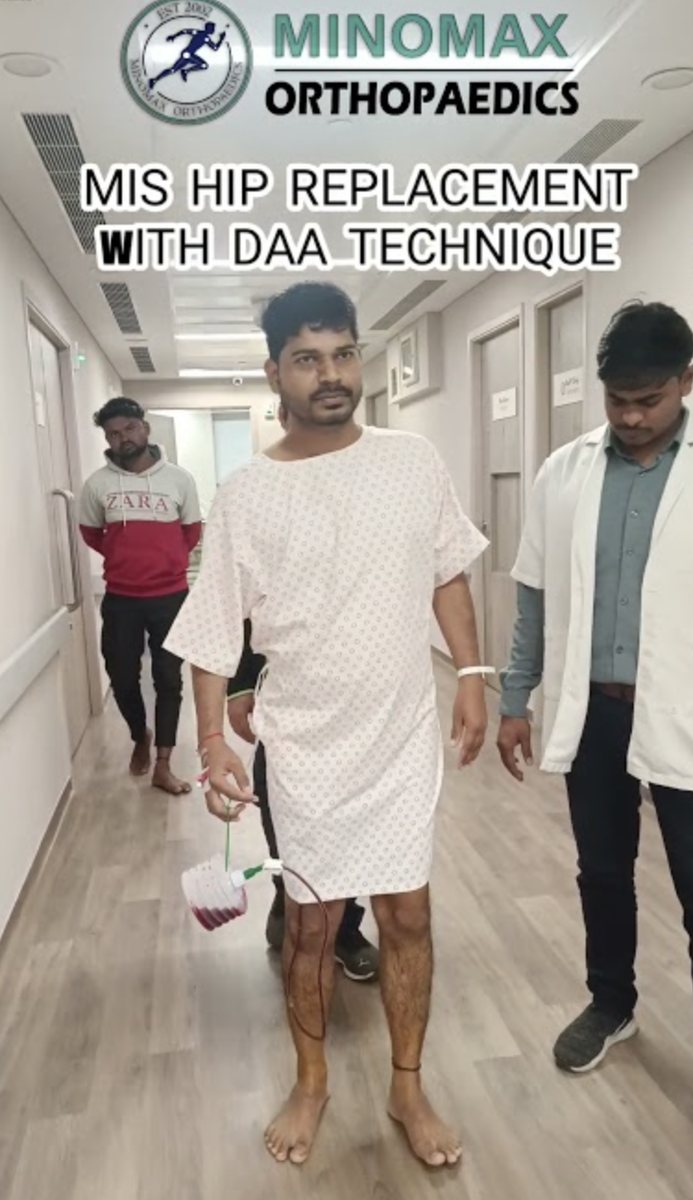
- Faster mobility — patients can often walk without support within two to four hours of surgery, without needing a walker or stick.
- Shorter hospital stay — typically reduced from around five days with traditional surgery to about three days with DAA.
- Less muscle damage and bleeding — because the approach works between muscles rather than cutting through them.
- More stable hip joint with a lower risk of post-surgery dislocation.
- Bilateral procedure possible — both hips can be replaced in a single surgical session when needed, sparing the patient a second operation.
- Equal leg length and precise implant positioning — because the patient lies on their back during DAA, leg length and implant alignment can be assessed with high accuracy.
- Reduced post-operative antibiotics and anaesthesia requirement.
- Lower risk of infection thanks to less blood loss and minimal tissue exposure.
How DAA Hip Replacement Is Performed
The DAA procedure follows a careful, step-by-step process:
- The patient is placed under general or regional anaesthesia, depending on the case.
- The surgeon makes a small incision at the front of the hip, accessing the joint through the TFL (tensor fasciae latae) muscle without splitting it.
- The surrounding muscles and tissues are gently moved aside to expose the hip joint — no major muscle is cut.
- The damaged femoral head and acetabulum are removed and replaced with a prosthetic joint, which consists of a femoral component (stem and head) and an acetabular component (cup).
- Robotic assistance can be used during this stage to provide real-time feedback on alignment, leg length, and implant positioning.
- The incision is closed using a cosmetic stitchless closure that does not require stitch removal and remains discreetly hidden in the groin crease, finished with a sterile dressing.
Cost of DAA Hip Replacement in Delhi
The cost of DAA hip replacement surgery in Delhi is shaped by several factors:
- The type and quality of implant used
- The patient’s overall health condition
- Duration of the hospital stay
- The hospital’s standard and facilities
- Whether ICU care is required during recovery
Because DAA uses specialised instruments and advanced surgical technology, the overall cost may be slightly higher than a standard hip replacement procedure in Delhi. Many patients find this difference well worth the investment, given the faster recovery, lower complication rates, and long-lasting outcomes.
Before, During, and After Surgery
Before the procedure
Dr. Maichand evaluates your health history through a detailed consultation and physical examination. An X-ray is usually ordered to confirm the diagnosis and reveal characteristic joint damage and calcium deposits. Based on the findings, a suitable date and surgical plan are discussed with the patient.
During the procedure
The patient lies on their back, which allows the surgical team to precisely assess leg length and implant alignment throughout the operation — something not always possible with side-lying approaches.
After the procedure
Once the surgery is complete, the patient is moved to the recovery room where vitals are continuously monitored. Most patients are discharged within two to three days. Before going home, a clear set of post-operative instructions is provided to ensure a smooth recovery.
Recovery and What to Expect
Recovery after DAA hip replacement is typically faster and more comfortable than with traditional approaches:
- Most patients stand and walk within two to four hours of surgery, often without a walker or stick.
- A crutch or stick may be used for additional support during the first one to two weeks.
- Complete recovery is typically achieved within two weeks, allowing a gradual return to everyday activities.
- High-impact or fall-risk activities — such as basketball, cricket, football, or skating — should be avoided to protect the implant.
- Lower-impact activities, including cross-legged sitting, squatting, skiing, and yoga, can typically be resumed once your surgeon confirms it is safe.
Is DAA Hip Replacement Suitable for Everyone?
While DAA is suitable for the majority of hip replacement patients, it is not the right choice in every case. Patients who are significantly overweight, or those who require revision (re-do) hip surgery, may need an alternative approach — such as the SuperPATH or Bikini Incision hip replacement techniques. Dr. Maichand assesses each case individually and recommends the surgical technique best suited to the patient’s anatomy and condition.
Why Choose Dr. Ashwani Maichand for DAA Hip Replacement in Delhi?
Dr. Ashwani Maichand is one of the most established orthopaedic surgeons in Delhi, well known for his expertise in joint replacement surgeries. His practice is built on:
- A patient-centric approach where care plans are tailored to the individual
- State-of-the-art surgical technology, including robotic assistance for precision
- Specialised instruments customised for accurate pre-operative planning and execution
- Comprehensive rehabilitation support so patients return to mobility with confidence
At Minomax Orthopaedics, the focus is on combining advanced techniques like DAA and MIS with personalised care — leading to consistently successful outcomes and faster recovery for hip replacement patients in Delhi.
Frequently Asked Questions
Conclusion
DAA hip replacement offers a less invasive, faster-recovery alternative to traditional hip replacement, with significant benefits for patients — from earlier mobility to shorter hospital stays and more stable long-term results. If you are considering hip replacement surgery in Delhi, a consultation with Dr. Ashwani Maichand at Minomax Orthopaedics can help determine whether DAA is the right approach for your specific case and goals.
Patient Stories and Videos